
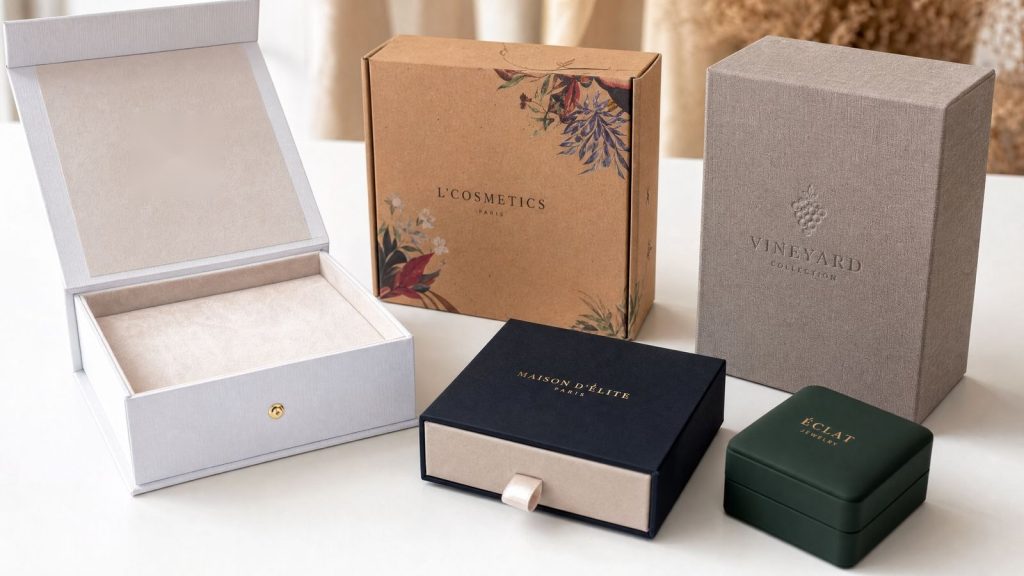
The price of a custom paper bag or rigid box is not set by the product name, but by a dozen decisions inside the specification. This guide walks through the factors that drive the cost of custom paper bags and rigid boxes, so you can read a quote with confidence — see also our guide to why two quotes can differ — and give a supplier the information needed for an accurate price.
Material
Material is often the largest single cost in a paper bag or box, and the choice you make here shapes everything else.
- Paper grade and fibre. Kraft paper, art paper, coated and uncoated boards all sit at different price points. Recycled and FSC-certified papers can cost more than standard grades, and availability varies — a grade that has to be ordered specially will cost more than one a supplier stocks.
- Weight and thickness. Heavier paper and thicker board cost more per piece and per shipment. A heavier sheet also makes a stronger bag, so the decision is a trade-off between cost and performance, not a straight saving.
- Colour of the material itself. White and natural kraft are usually the lowest-cost options. Dyed or specially coloured papers are produced in smaller volumes and cost more.
If a quote seems high, ask which material was priced. Changing the paper grade is often the simplest way to move the price — but check the effect on strength and print quality first.
Size and Structure
Size drives material usage directly: a larger bag uses more paper, more board, and more space in shipping. But structure matters just as much.
- A simple flat paper bag is the least expensive structure to make: few parts, fast to run, easy to pack flat.
- A rigid gift box costs more because it is built from several parts — the box body, the lid, the wrapping paper, and often an insert — and each part is produced and assembled separately.
- Handles, closures and inserts add material and labour. Rope handles, ribbon handles, magnetic closures and fitted inserts each add a step and a cost.
- Flat-pack vs assembled. Boxes shipped flat cost less to freight but need assembly at your end; assembled boxes cost more to ship but arrive ready to use.
When comparing quotes, check that both suppliers priced the same structure. A rigid box and a folding carton that look similar on a screen are not the same product.
Printing
Printing cost depends on how much ink, how many plates, and how much press time your design needs.
- Number of colours. Each colour needs its own plate and its own pass on the press. A one- or two-colour design is materially cheaper to set up than a full-colour design.
- Coverage. A design with large areas of solid colour uses more ink and takes longer to dry than a small logo on a plain background.
- Print method and registration. Tight registration between colours, printing on both sides, and printing inside the bag or box all add time.
- Proofing. A printed proof or a pre-production sample adds a small cost up front and is the cheapest way to avoid reprinting a full run.
Simplifying artwork — fewer colours, smaller print areas — is one of the fastest ways to reduce a quote, and it often has no visible effect on the finished bag.
Finishing
Finishing is what makes a bag or box look premium, and it is also where costs can rise quickly, because each process needs its own setup, die or plate:
- Foil stamping adds a metallic or coloured foil detail. It needs a heated die made for your artwork.
- Embossing and debossing press a raised or recessed pattern into the paper. They need a matched die set.
- Lamination — matt or gloss film — protects the print and changes the feel. It adds a material and a process step.
- Spot UV adds a raised gloss varnish to selected areas, usually a logo or pattern.
A design with three finishing processes will cost noticeably more than the same design with one. When you brief a supplier, say which finishes matter to you and which are optional — it gives them room to propose a lower-cost version.
Quantity and Unit Cost
Quantity is the most powerful lever on unit price. The fixed costs of a job — plates, dies, machine setup — are the same whether you order 500 or 5,000 pieces, so they are spread thinner as the run gets longer. That is why the unit price falls as quantity rises.
But the total cost still goes up, and a larger order ties up cash and storage. The right quantity is a balance — enough to get a sensible unit price, not so many that you are storing packaging you may never use. See our guide to minimum order quantities for how to weigh unit price against total cost.
Tooling, Sampling and Freight
Three costs that buyers often miss:
- Tooling. Cutting dies and printing plates are usually charged once per design. On a reorder of the same design they are typically reused, which is one reason reorders cost less to set up.
- Sampling. A sample round costs time and material, and some suppliers charge for it. It is still the cheapest insurance against a full run of the wrong product. At PackSavvy, sampling typically takes 7–15 days.
- Freight. Packaging is bulky. Freight depends on weight, volume, destination and shipping method, and for large or rigid boxes it can be a significant part of the landed cost. Ask whether the quote includes freight or is ex-works, and compare like with like.
What to Include in a Quote Request
A supplier can only price what you describe. The more complete your brief, the more accurate — and comparable — the quotes you receive. Include:
- Product type — paper bag, rigid box, or accessory — and the intended use.
- Size — length × width × height, or the size of the product it must hold.
- Quantity — the number you need now, and whether you will reorder.
- Material — paper or board type and weight, if you know it; otherwise describe the look and strength you need.
- Printing — number of colours, print areas, and whether the inside is printed.
- Finishing — foil, embossing, lamination, spot UV, or none.
- Handles, closures and inserts — if any.
- Target date — when you need the goods, and the delivery address.
If you do not know the material or the best structure, say so. A good supplier will propose options at different price points rather than guessing on your behalf.
If you would like a price for your project, send us the details above and we will quote for your specification. You can start by looking at the product range — gift boxes and paper shopping bags — or go straight to an enquiry.
Sources
- PackSavvy — Products: https://packsavvypkg.com/products/
- PackSavvy — Factory & Equipment: https://packsavvypkg.com/factory/
- PackSavvy — Why Us / Service & Quality: https://packsavvypkg.com/why-us/
© 2026 PackSavvy. Original editorial content and proprietary materials. All rights reserved where applicable.
For permission to reproduce, translate, or commercially reuse our proprietary content, please contact PackSavvy.