
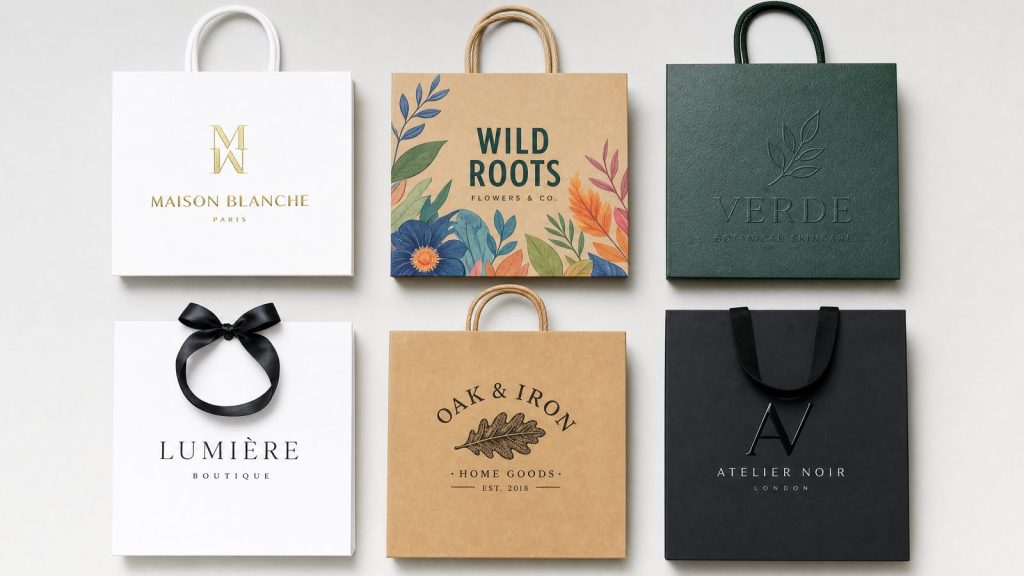
If you have ever asked for a quote on custom paper bags or rigid gift boxes, you have probably run into three letters early in the conversation: MOQ, or minimum order quantity. It is often the first surprise in a custom packaging project — and the most misunderstood. This guide explains what MOQ is, why suppliers set one, what makes it go up or down, and what you can do about it.
What MOQ Actually Is
A minimum order quantity is the smallest number of units a supplier will produce in a single order. It is not a sales tactic and it is not negotiable in the way a unit price is. It reflects the point at which a production run becomes practical: the machines are set up, the materials are ordered, the print plates are made, and the run has to be long enough for all of that to make sense.
MOQ is always stated per product and per specification. A plain kraft shopping bag and a rigid gift box with foil stamping and a magnetic closure will not have the same minimum, even from the same supplier. When a supplier quotes an MOQ, it applies to one defined product — one size, one material, one print design — not to a mixed basket of different items.
Why Suppliers Set a Minimum
Custom packaging is made to order, and every order carries fixed setup work that does not depend on how many pieces you buy:
- Machine setup. Printing presses, die-cutters and finishing equipment must be set up and calibrated for your job, then cleaned down afterwards. That time costs the same whether the run is 500 pieces or 50,000.
- Plates and dies. Printing plates and cutting dies are made once per design. Their cost is spread across the run, so a very short run carries a very high setup cost per piece.
- Material purchasing. Paper and board are bought in reels or sheets, in mill quantities. A supplier cannot buy a fraction of a reel for a tiny order without wasting material or paying a premium.
- Quality control and handling. Inspection, packing and dispatch have a fixed cost per order, whatever the quantity.
Below a certain quantity, the setup cost per piece becomes so high that the product is no longer worth producing — for the supplier or for you. The MOQ is the line below which the numbers stop working.
What Affects the MOQ
Not all products have the same minimum. These are the factors that move it:
Material. Standard materials that a supplier stocks and uses every day usually carry the lowest minimums. A special paper, an unusual board grade, or a material that has to be specially ordered will push the minimum up, because the supplier has to buy a full mill quantity.
Printing. More print colours generally mean more plates and longer setup. A one-colour print is simpler to set up than a five-colour design with tight registration. Large areas of solid colour and special inks can also add setup time.
Finishing. Each finishing step — foil stamping, embossing, lamination, spot UV — needs its own setup and its own die or plate. A box with three finishing processes will have a higher minimum than the same box plain.
Size and structure. Larger or more complex structures use more material per piece and take longer on the machines. A rigid box, which is assembled from several parts, involves more steps than a flat folding bag.
Order complexity. One design in one size is one production run. Five designs in five sizes are five runs, each with its own minimum — even if the total quantity across all five looks large.
What “MOQ from 500 Pieces for Selected Products” Means
At PackSavvy, the minimum order quantity starts from 500 pieces for selected products. That wording matters, and it is worth reading carefully:
- “From 500 pieces” is a starting point, not a promise for every product. The exact minimum depends on the product, size, material, printing and finishing.
- “For selected products” means the 500-piece starting point applies to the products it is quoted for — not to everything in the catalogue. A complex rigid box may need more; a simple standard bag may start at 500.
- Ask per project. The only reliable MOQ for your order is the one quoted for your specification. Give the supplier the size, material, quantity, print and finishing, and the MOQ will be part of the answer.
If a supplier tells you a single MOQ figure without asking what you want made, treat it as a rough indication, not a commitment.
Unit Cost vs Total Cost
A higher MOQ often means a lower unit price, because the fixed setup cost is spread across more pieces. That creates a real decision for buyers:
- Ordering 500 pieces at a higher unit price may cost less in total than ordering 2,000 at a lower unit price — but you may be left with stock you do not need.
- Ordering the larger quantity saves per piece, but ties up cash and storage, and risks waste if the design changes.
There is no universally right answer. It depends on how fast you will use the packaging, whether the design is likely to change, and how much storage you have. A good supplier will show you the unit price at two or three quantities so you can make the comparison yourself.
What Buyers Can Do About MOQ
You cannot remove a minimum, but you can often work with it:
- Standardise. Using a standard size and a stocked material keeps you at the lowest minimum. Custom sizes and special materials raise it.
- Simplify the print. Fewer colours and simpler artwork reduce setup and can bring the minimum down.
- Consolidate designs. If you need several designs, ask whether a shared size and material lets them run more efficiently — but expect each design to carry its own minimum.
- Plan reorders. If you will reorder the same design, say so. A repeat order reuses plates and dies, which is why reorders are usually simpler and faster than first orders.
- Start with samples. Before committing to a full run, ask for samples. At PackSavvy, sampling typically takes 7–15 days, and production can take as little as 30 days for applicable orders — so a sample round seldom adds much time to a project, and it removes the risk of ordering 500 pieces of the wrong thing.
What to Ask Before You Commit
Before you place an order, get these answers in writing:
- What is the MOQ for this exact specification — size, material, print, finishing?
- What is the unit price at the MOQ, and at the next quantity up?
- Are plates, dies and tooling included in the quote, or charged separately?
- What does sampling cost, and how long does it take?
- What is the production lead time once the sample is approved?
- What happens if I need to reorder — is the MOQ the same, and are the plates and dies kept?
A supplier who answers these clearly is a supplier you can plan around.
If you are planning a custom packaging order, tell us the product, size, material and quantity you have in mind, and we will confirm the minimum order quantity and unit price for your specification. You can see the product range first, or go straight to an enquiry.
Sources
- PackSavvy — Products: https://packsavvypkg.com/products/
- PackSavvy — Why Us / Service & Quality: https://packsavvypkg.com/why-us/
© 2026 PackSavvy. Original editorial content and proprietary materials. All rights reserved where applicable.
For permission to reproduce, translate, or commercially reuse our proprietary content, please contact PackSavvy.