
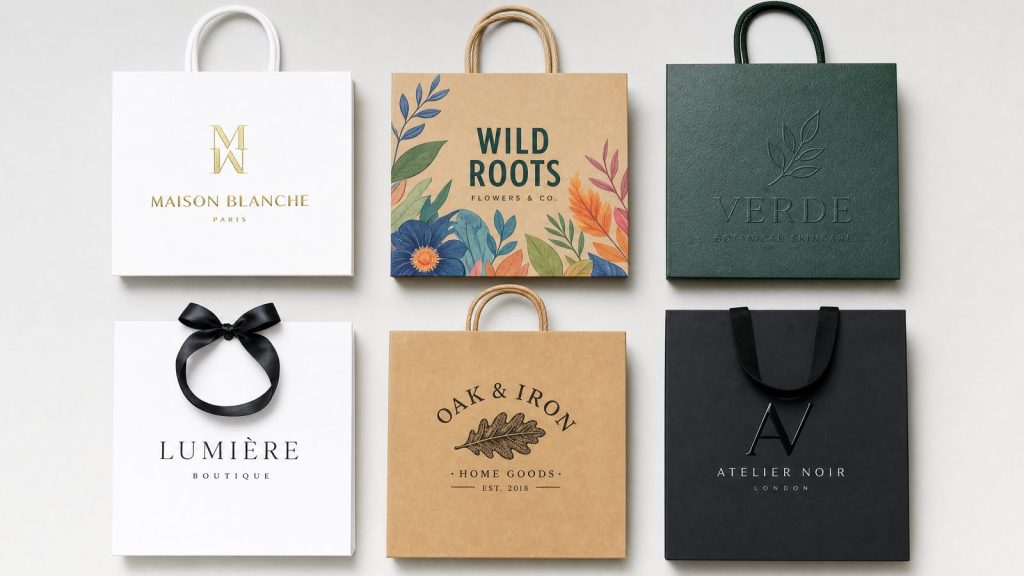
Ask three suppliers for a price on the same paper bag and you will usually get three different answers — sometimes 20%, 50% or even 100% apart, according to one supplier guide. The instinct is to assume someone is overcharging. More often, the quotes describe three different bags.
A quote is a price for the product described in it. Two suppliers rarely describe the same product unless the buyer forces them to. One quotes heavier paper, another thinner board, a third leaves out the printing plates — or prices a different delivery term. The numbers look comparable; the products behind them are not. The cheapest quote is rarely the cheapest order.
1. Paper Grade and GSM
Paper is the first place quotes diverge, and the hardest place to spot it. GSM — grams per square metre — is the weight of the paper, not its strength, and two bags at the same GSM can carry very different loads depending on fibre and construction; see our GSM guide for the detail.
So when one quote says “150 gsm kraft” and another says “150 gsm”, they may not be quoting the same material at all — and when one says “kraft” and the other says “art paper”, they are quoting different products at different costs with different print and strength. Always check the paper type and the fibre source, not just the GSM number. If a quote does not name the paper, it has not specified the material.
2. Size and Construction
Bag dimensions directly decide how much paper an order uses, so even a small size difference moves the price. But construction matters as much as size: two bags with similar external dimensions can cost different amounts because one has a reinforced bottom, a deeper top fold, a glued handle patch or a bottom insert board and the other does not. A bag that carries its load on a reinforced base and anchored handles is a different product from a bag that is just folded and glued.
This is why suppliers need exact dimensions before giving an accurate quotation — width × gusset × height, plus the weight of the contents. A quote based on “about A4 size” is a guess, and two guesses will not match.
3. Print Colours and Coverage
Simple one-colour printing is generally more economical than full-colour printing, and the gap grows with coverage. One supplier may count four print colours while another counts two; one may price a full-bleed photographic print while another prices a small logo. If the artwork is not attached to the enquiry, each supplier imagines a different print job.
Plates are part of this. Flexo and offset printing need plates, and plates cost money whether they appear on the quote or not. A supplier who leaves plates out of the unit price and charges them after the order is placed has not quoted a lower price — only a later one. Ask whether plates are included, and whether the quoted print method is the one you asked for.
4. Finishing
Finishing is a set of separate processes, each with its own cost: lamination (matte or gloss), foil stamping, embossing, debossing and spot UV. A bag with foil on the logo and soft-touch lamination is not the same product as the same bag without them, and the price difference is real.
When comparing quotes, check whether the suppliers are offering the same finishing specification — not just the same bag. “With lamination” and “without lamination” should never be compared as if they were the same item, and a quote that does not mention finishing at all has probably not included it.
5. Handles and Reinforcement
Handles are one of the most commonly overlooked lines in a paper bag quote. Twisted paper handles, flat paper handles, cotton rope, PP rope, ribbon and die-cut handles all cost different amounts, and the anchoring matters as much as the handle itself: a glued reinforcement patch, a board strip inside the top fold for rope handles, or eyelets each add cost — and each adds carrying capacity.
A quote that prices the bag without handles, or with the cheapest handle, will look lower than a quote that includes rope handles with a reinforced top fold. They are not the same bag. Name the handle type and the reinforcement in your specification, and check both on every quote you receive.
6. Quantity and MOQ
Small orders almost always have higher unit costs, because setup — plates, dies, machine make-ready — is spread across fewer pieces. This is one of the biggest reasons the same bag can look expensive from one supplier and cheap from another: they may be quoting different quantities, or different assumptions about the minimum order.
At PackSavvy, the minimum order quantity starts from 500 pieces for selected products, and the specific MOQ depends on the product, size, material, printing and finishing. When you compare quotes, compare them at the same quantity, and check whether each supplier’s price is for that quantity or for their own minimum.
7. Tooling, Sampling and Plates
Beyond plates, there are cutting dies, assembly jigs and sampling. Sampling typically takes 7–15 days, and a pre-production sample is the only reliable way to confirm that the paper, print and handles you specified are the ones you will receive. Some quotes include a sample in the price; others charge for it separately; some do not offer one at all.
Ask explicitly: are plates, dies and sampling included, charged separately, or excluded? A blank line on a quote is a question, not an assumed inclusion.
8. Freight, Delivery Terms and Packing
Two suppliers can offer similar factory prices and very different delivered costs. One quote may be priced ex-works, where you arrange and pay for all transport, while another includes freight to your destination port. One may ask for full payment before production while another splits payment between order and shipment.
Packing counts too. Some suppliers quote only the product; others include polybags, hangtags, barcode labels, export cartons and carton marks. Compare the total landed cost — product, packing and freight to your door — rather than the unit price alone.
9. What Is Included — and What Isn’t
The pattern behind all eight points is the same: the unit price tells you almost nothing until you know what it covers. Before you compare two totals, check each of these on both quotes:
- Paper type, GSM and fibre source
- Exact size and construction, including reinforcement
- Print colours, coverage and method, and whether plates are included
- Finishing, line by line
- Handle type and anchoring
- Quantity, and whether the price is for that quantity
- Tooling, dies and sampling
- Packing, freight and delivery terms
- Payment terms, production time and quote validity
Production time counts too: at PackSavvy, production can take as little as 30 days for applicable orders — confirm the time for your order on the quote.
How to Compare Quotes Like for Like
The fix is simple to describe and worth the effort: write one specification sheet and send it to every supplier, so each quote prices the same product. A specification sheet lists material, weight, size, print colours, finishing, handles, quantity, packing and delivery terms in one document. A supplier who quotes without it is guessing, and you cannot tell what the price covers.
Then compare the quotes on a sheet of your own. For each line, mark it included, separate, excluded or pending — and treat a blank cell as a question, not an assumed inclusion.
| Line | What to check |
|---|---|
| Paper | Type, GSM, virgin or recycled |
| Size | Width × gusset × height; contents weight |
| Construction | Bottom, top fold, handle patch, bottom board |
| Colours, coverage, method; plates included? | |
| Finishing | Lamination, foil, embossing, spot UV — each line |
| Handles | Type and anchoring |
| Quantity | Same quantity on every quote |
| Tooling | Plates, dies, sampling — included or separate? |
| Packing | Polybag, hangtag, export carton, marks |
| Freight | Ex-works or delivered; to which point? |
| Terms | Payment, production time, validity date |
Ask for a sample before the full run, and judge the samples side by side — not just the prices. A bag that looks identical in a photograph can feel and perform very differently in the hand.
If you have two quotes that do not match and want a straight answer on what is different, send us both specifications — or just your bag size, contents and quantities — and we will price the same bag on the same terms so you can compare properly. See our paper shopping bags and premium gift boxes, or contact us with your specification.
Sources
- Kadi Paper, “How to Compare Packaging Quotes: A Wholesale Buyer’s Guide” — https://kadipaper.com/blog/comparing-packaging-quotes-guide/
- Jeeli Packaging, “Same Paper Bag, Very Different Quotes — What’s Actually Changing the Price?” — https://www.jeelipackaging.com/posts/why-custom-paper-bag-quotes-vary
- LinHord, “Compare custom bag quotations” — https://www.linhord.com/journal/compare-custom-bag-quotations/
- Degu Sabags, “Why Do Different Suppliers Quote Different Prices for the Same Bag?” — https://www.degusabags.com/blog/different-suppliers-different-prices-same-bag
- BK-Bags / Global Bioenergy, “Paper Bags: The Complete Guide for Retail Buyers (Part 1)” — https://www.globalbioenergy.org/paper-bags-guide-retail-buyers/
- Best Pack Factory, “Paper Bag GSM vs Load: Choosing Weight and Handles” — https://www.bestpackfactory.com/blog/paper-bag-paper-weight-gsm-load-guide.html
- PackSavvy website, Products and Factory pages — https://packsavvypkg.com/products/ and https://packsavvypkg.com/factory/
© 2026 PackSavvy. Original editorial content and proprietary materials. All rights reserved where applicable.
For permission to reproduce, translate, or commercially reuse our proprietary content, please contact PackSavvy.