

A Practical Guide to Custom Paper Bag Dimensions, Paper Weight, Handles, and Structural Design
A well-designed paper shopping bag does more than carry a product. It protects the contents, represents the brand, and provides a comfortable carrying experience.
For packaging buyers, choosing the right bag size and material is one of the most important decisions in custom paper bag production. A bag that is too large wastes material and increases shipping volume. A bag that is too small may damage the product or make packing difficult. Choosing the wrong paper or handle construction can also affect durability and cost.
This guide explains how to determine practical shopping bag dimensions, select suitable paper materials, and balance strength, appearance, and production efficiency.
1. Understanding Paper Shopping Bag Dimensions
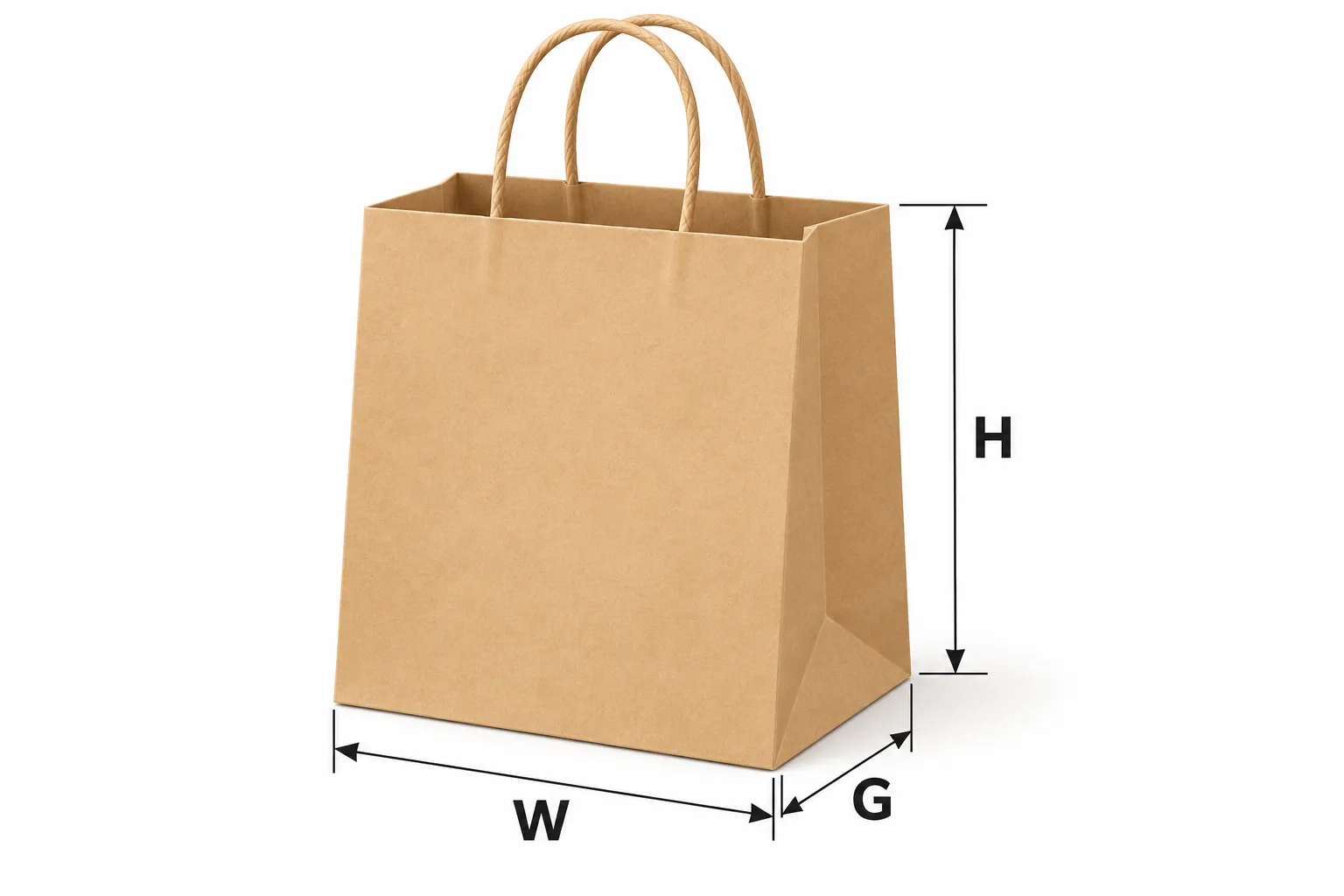
Most custom paper shopping bags are specified using three dimensions:
Width × Gusset × Height (W × G × H)
- Width (W): The horizontal measurement across the front panel.
- Gusset (G): The depth of the bag when opened, measured from front to back.
- Height (H): The vertical measurement from the bottom to the top opening, excluding the handles.
For example, a bag measuring 300 × 120 × 400 mm has a front width of 300 mm, a gusset of 120 mm, and a height of 400 mm.
These are generally the nominal finished dimensions. Actual usable internal space may be slightly smaller because of folds, bottom construction, paper thickness, and manufacturing tolerances.
Important: Different suppliers may use different dimension sequences. Always confirm the order of measurements on the quotation and production drawing.
2. How to Calculate the Right Bag Size
The best starting point is the actual product or retail box that will go inside the bag. Measure the product’s width, depth, and height in the orientation in which it will be packed. Then allow enough clearance for easy insertion and removal.
Step 1: Measure the Product
Suppose a gift box measures:
- Width: 250 mm / Depth: 100 mm / Height: 300 mm
Step 2: Allow Packing Clearance
As an initial design allowance, consider approximately 10–20 mm of additional space in width and depth, depending on the product and packing method. The bag should not fit so tightly that workers need to force the product inside.
Step 3: Determine Bag Height
Bag height needs additional consideration. The product should sit comfortably inside the bag without protruding excessively from the opening. The required headroom depends on the desired appearance, product protection, and handle arrangement.
For the example above, a possible starting specification is 270 × 120 × 350 mm (W × G × H). This provides additional room around the gift box and approximately 50 mm of nominal height above it.
However, this is a preliminary size, not a guaranteed fit. A physical sample should be tested before mass production.
Why Product Orientation Matters
A rectangular product may fit into a bag in more than one orientation. Changing the orientation can significantly affect the required bag dimensions, paper consumption, and visual proportions.
For example, a wide, shallow bag may work better for apparel, while a narrower and taller bag may be more suitable for cosmetics or bottled products.
The goal is not simply to make the product fit. It is to find a practical size that also looks balanced and uses material efficiently.
3. Choosing the Right Paper Material
Paper selection affects the appearance, strength, printing quality, environmental characteristics, and price of a shopping bag. The most common options include white kraft paper, brown kraft paper, and coated art paper.

White Kraft Paper
White kraft paper is widely used for retail shopping bags that require a clean appearance and good strength. Its relatively strong fiber structure makes it suitable for many everyday retail applications. Common applications include fashion retail, cosmetics, lifestyle products, and branded shopping bags.
White kraft paper can be a practical choice when buyers want a balance of printability, durability, and cost. However, not all white kraft papers perform identically. Strength and surface characteristics depend on the specific paper grade and manufacturer.
Brown Kraft Paper
Brown kraft paper provides a natural, understated appearance. It is commonly selected for grocery bags, takeaway packaging, lifestyle products, and brands seeking a natural paper aesthetic.
Its natural brown surface affects printed colors. Light colors and highly saturated graphics may require special consideration or a white ink underlayer where the printing process supports it.
Brown kraft paper is not automatically stronger or more environmentally friendly than every other paper grade. Those properties depend on its composition, production process, and certification.
Coated Art Paper
Coated art paper is often used for premium retail shopping bags requiring detailed graphics and smooth printing surfaces. It is particularly suitable for high-quality photographic images, fine text, and sophisticated color reproduction.
However, coated art paper may not provide the same tear resistance as an appropriate kraft grade of similar weight. For heavier products, additional reinforcement and suitable handle construction may be necessary.
Lamination can improve certain surface properties and appearance, but may also affect recyclability depending on the film and local recycling infrastructure.
4. How to Choose Paper Weight (GSM)
GSM stands for grams per square meter. It measures the basis weight of paper.
A higher GSM generally means more paper mass per unit area, but higher GSM does not automatically mean a stronger shopping bag. Strength also depends on fiber composition, tensile properties, tear resistance, moisture conditions, grain direction, and bag construction.
| Paper Weight | Typical Considerations |
|---|---|
| 100–120 GSM | Lightweight bags for smaller or lighter products |
| 120–150 GSM | Common retail applications with moderate strength requirements |
| 150–190 GSM | Premium retail bags requiring a more substantial feel |
| 190–250 GSM | Heavier, more structured presentation bags, subject to material and machine suitability |
These are indicative ranges rather than universal load ratings. Paper grade and construction must be considered together. For example, a 150 GSM kraft paper bag may perform differently from a 200 GSM coated paper bag.
Before choosing a heavier paper, consider whether the additional material actually improves the required performance. Sometimes a better handle attachment or stronger bottom construction provides more practical value than simply increasing GSM.
For a deeper look at paper weight, see our Custom Paper Bag GSM Guide
5. Choosing the Right Handle
Handles are one of the most important structural components of a paper shopping bag. A poorly selected handle can fail even when the bag body is sufficiently strong.
Twisted Paper Handles
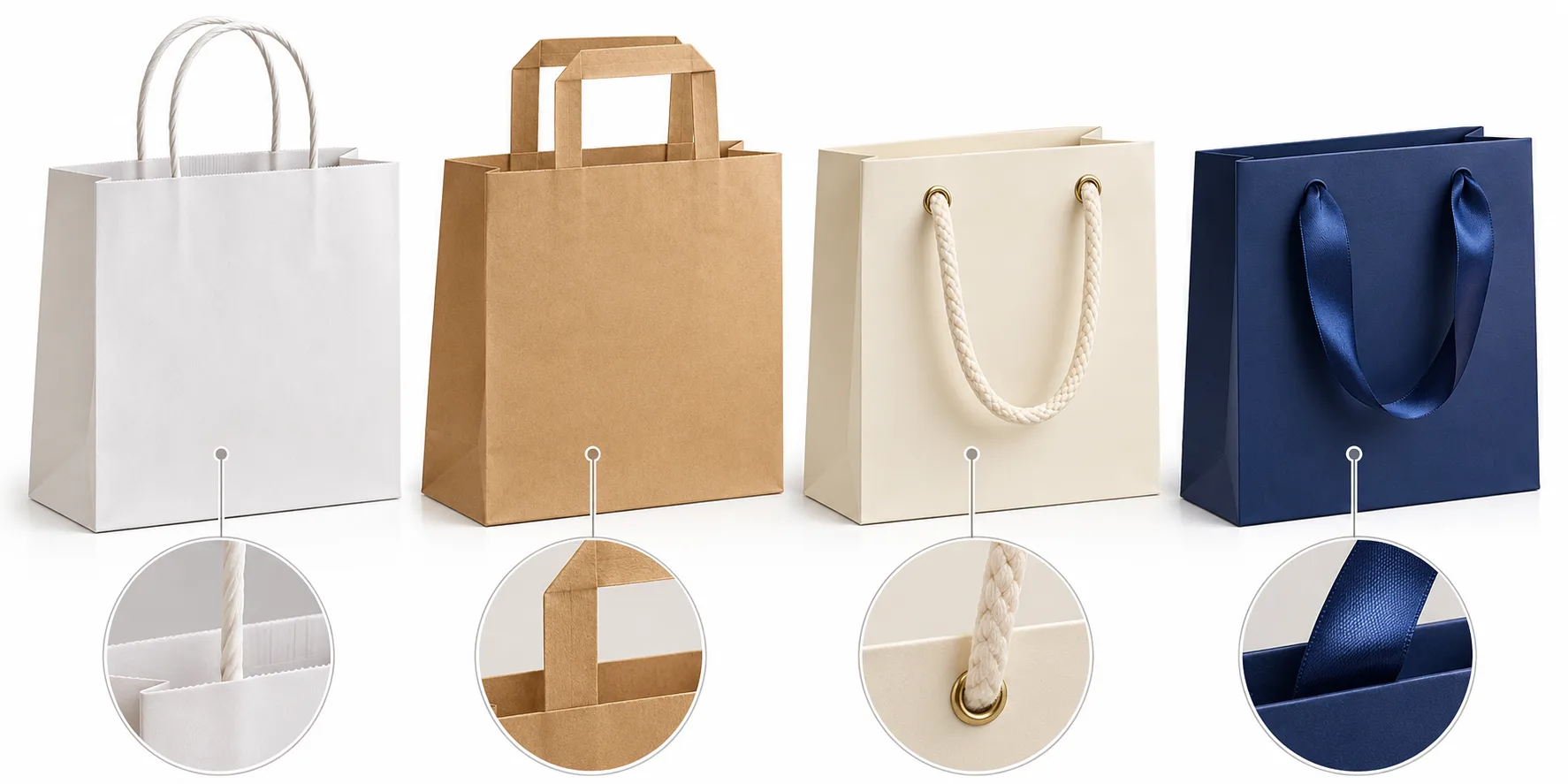
Twisted paper handles are commonly used for retail and takeaway bags. They offer a practical balance of cost, convenience, and production efficiency. They are often suitable for medium-volume production and applications where a simple paper-based construction is preferred.
Flat Paper Handles
Flat paper handles are widely used for grocery, takeaway, and general retail bags. They can be economical and suitable for automated bag production. The attachment method and intended load should be evaluated before confirming the specification.
Cotton Rope Handles
Cotton rope handles are often selected for premium retail and gift packaging. They offer a soft hand feel and a more refined appearance. However, rope diameter, handle length, hole placement, and reinforcement must all be considered.
Ribbon Handles
Ribbon handles are frequently used for luxury packaging, cosmetics, jewelry, and gift bags. They provide a decorative appearance but may not be the best choice for every heavy-load application.
Handle selection should consider both appearance and practical carrying performance.
6. Reinforcing the Top and Bottom
For premium shopping bags, the paper itself is only one part of the structural design. Two areas deserve particular attention.
Top Reinforcement
A folded top edge can improve the finish and provide additional structural support. Some bags use reinforcement cards around the handle attachment area. The appropriate construction depends on the handle type, paper grade, intended load, and production method.
Bottom Reinforcement
A bottom reinforcement card can help distribute product weight and provide a flatter supporting surface. This is particularly useful for rigid gift boxes, cosmetics sets, and products with concentrated weight.
However, a bottom card alone cannot compensate for weak side seams or poor handle attachment. The bag should be evaluated as a complete structure.
7. How Bag Dimensions Affect Cost
Bag size has a direct impact on material consumption. Increasing the width, gusset, or height generally increases the amount of paper required. But the relationship between dimensions and cost is not always proportional.
Two bags with similar finished dimensions may have different production costs because of:
- Paper sheet or roll utilization
- Printing layout and production method
- Machine size limitations
- Paper grain direction
- Handle type and attachment process
- Reinforcement materials
- Finishing requirements
- Order quantity and production waste
A small adjustment to bag dimensions can sometimes improve paper utilization and reduce waste. For this reason, packaging buyers should avoid fixing every dimension before discussing the design with their supplier.
If the product allows some flexibility, the supplier may be able to recommend a more economical size without compromising usability.
For more on what drives bag pricing, see What Affects the Cost of Custom Paper Bags and Boxes
8. Common Mistakes When Designing Shopping Bags
Choosing dimensions based only on appearance. A visually attractive bag may still be difficult to pack or carry. Always consider the actual product dimensions and packing process.
Assuming thicker paper is always stronger. Paper weight alone does not determine finished bag performance. Material properties and construction are equally important.
Ignoring handle strength. A bag can fail at the handle attachment points before the paper body tears.
Making the gusset too narrow. An insufficient gusset can prevent the product from sitting flat and may distort the bag when filled.
Overlooking shipping efficiency. Oversized bags take up more space during storage and transport and may increase packaging costs.
Skipping physical samples. A digital drawing cannot fully demonstrate how a finished bag behaves when loaded, carried, or packed.
9. What to Confirm Before Mass Production
Before approving a custom shopping bag order, confirm the following details with your supplier:
- Finished bag dimensions and measurement sequence
- Product dimensions and intended packing orientation
- Product weight and expected carrying conditions
- Paper grade, GSM, and surface finish
- Handle material, dimensions, and attachment method
- Top and bottom reinforcement requirements
- Printing colors and finishing processes
- Quantity, packing requirements, and delivery expectations
For products with significant weight, the supplier should evaluate the complete bag construction and conduct suitable load or handling tests. A production sample should be checked with the actual product whenever possible.
Order quantity also affects minimums and pricing — see Understanding MOQ in Custom Packaging
10. Final Thoughts: Design the Bag Around the Product
There is no single ideal paper shopping bag size or material for every application. The best specification depends on the product, desired brand presentation, carrying requirements, production process, and budget.
A successful design balances these factors rather than focusing on size, paper thickness, or appearance alone.
At PackSavvy, we help packaging buyers evaluate bag dimensions, paper options, handle construction, and manufacturing considerations to develop practical custom packaging solutions.
Planning a Custom Paper Shopping Bag?
Share your product dimensions, approximate weight, preferred appearance, and order quantity. Our team can help you evaluate suitable bag sizes, materials, and construction options.
© 2026 PackSavvy. Original editorial content and proprietary materials. All rights reserved where applicable.
For permission to reproduce, translate, or commercially reuse our proprietary content, please contact PackSavvy.