
Understanding screen-printed inks, screen-applied spot UV, and premium packaging finishes
When sourcing custom paper shopping bags, rigid gift boxes, or folding cartons, buyers may find “screen printing” and “spot UV” listed as separate items on a supplier’s quotation or production order. Yet spot UV is often applied using screen-printing equipment. Why are they listed separately?
The answer is that screen printing describes an application method, while spot UV describes a selective UV-curable coating and its finishing effect. In everyday factory terminology, “screen printing” often means printing with colored ink, whereas “spot UV” means applying UV varnish—even if both use a mesh screen and squeegee.
1. What Is Screen Printing?
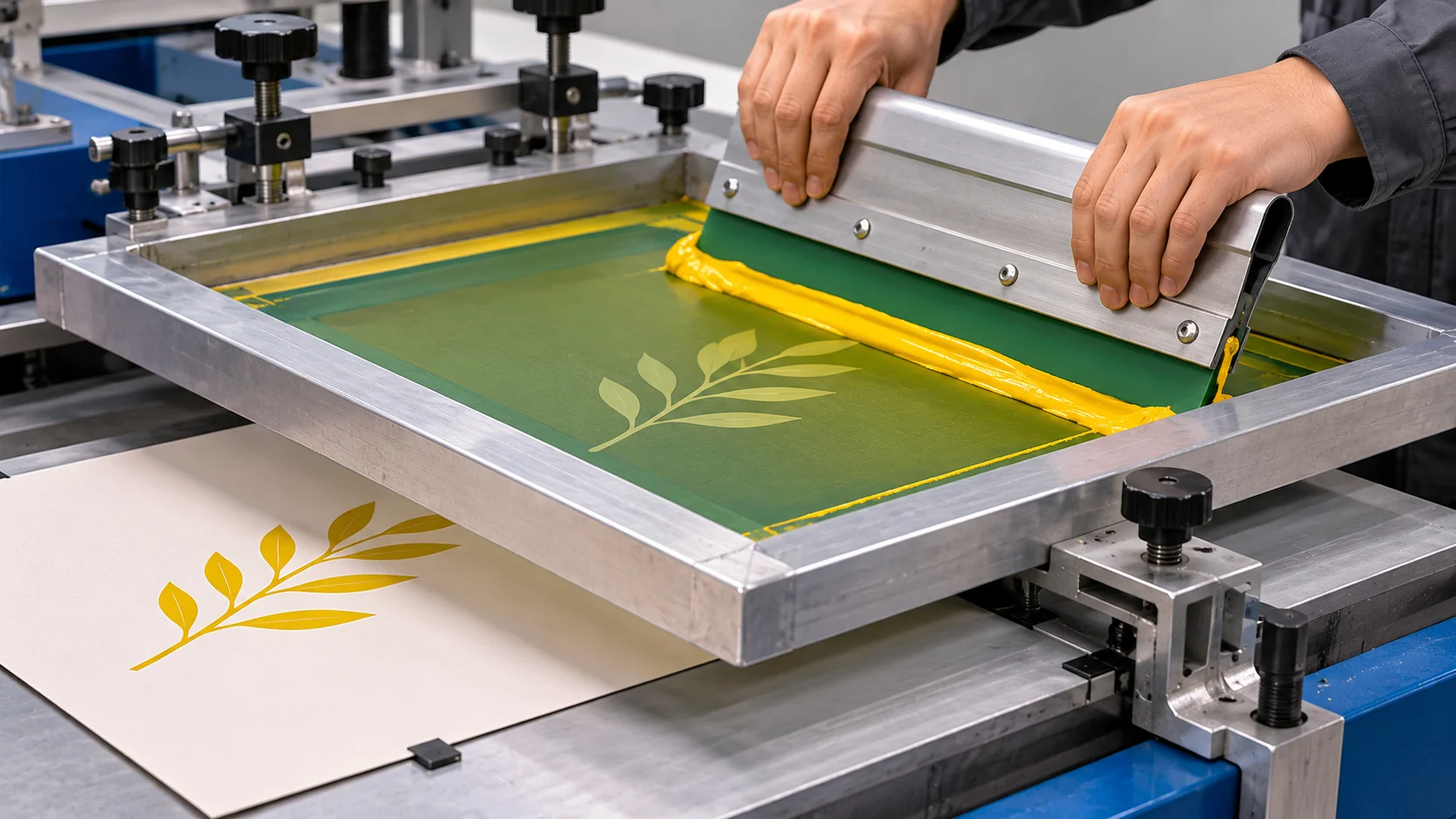
Screen printing transfers ink or coating through the open areas of a mesh stencil onto a substrate. A squeegee pushes the material through the mesh, while blocked areas prevent transfer. The process can be used with conventional, specialty, or UV-curable inks, as well as selected coatings.
In packaging factories, screen printing is commonly used for opaque white logos on dark or specialty paper surfaces. Other spot colors and specialty inks can also be applied when the substrate, artwork, and desired finish make screen printing a suitable choice.
Opacity, deposit thickness, adhesion, and finish depend on the ink, mesh, stencil, and substrate.
Screen printing is useful for certain spot colors and specialty effects, but it is not necessarily the best choice for photographic artwork or complex multicolor gradients.
2. What Is Spot UV Coating?
Spot UV applies a UV-curable varnish to selected areas of a surface. The coating is then cured using an appropriate UV light source. Standard clear gloss spot UV changes how the surface reflects light rather than printing a new opaque color.
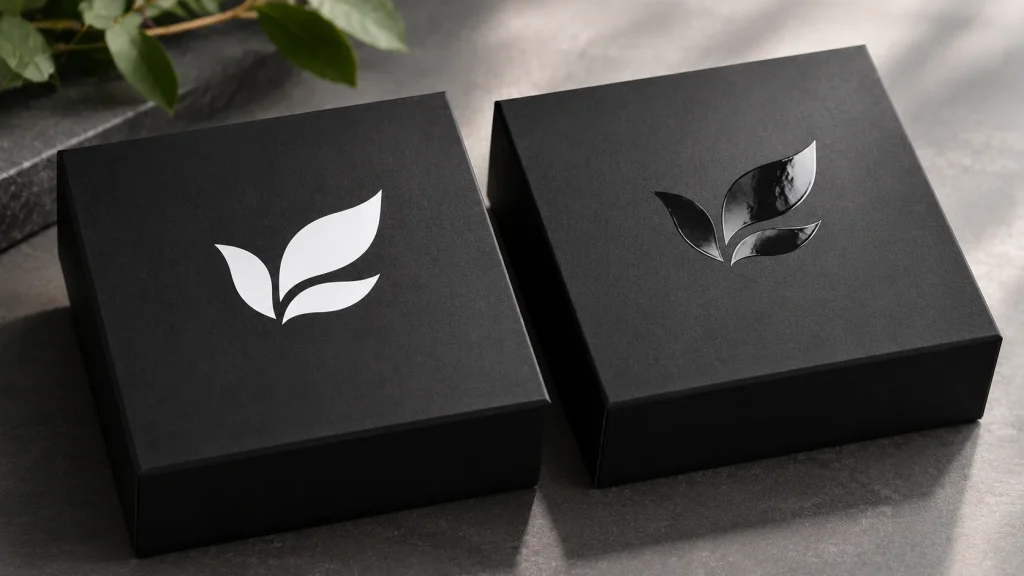
For example, a glossy black logo on a matte black rigid box can be created with clear spot UV. The contrast comes from gloss, not a white or colored pigment.
Spot UV may be applied through a screen, or by other compatible coating and digital enhancement systems. Screen-applied spot UV is common in packaging production, especially when a relatively substantial coating deposit or a special texture is desired.
3. Why Do Factories List “Screen Printing” and “Spot UV” Separately?
Production orders are designed to tell operators what material to apply and what result to achieve, not necessarily to classify every process by its underlying mechanics.
Consider two orders for matte black rigid gift boxes:
- Screen printing: Print an opaque white logo or other selected spot-color graphics using suitable screen-printing inks, particularly on dark or specialty paper surfaces.
- Spot UV: Apply clear gloss UV varnish to a selected logo area.
Both may be carried out using screen-printing equipment. However, their materials, setup, curing or drying requirements, appearance, and quality checks differ. Listing them separately is a practical way to organize production and costing.
The distinction matters when communicating with buyers: screen printing is not the opposite of spot UV; screen printing can be the method used to apply spot UV.
4. Screen-Printed Ink vs. Screen-Applied Spot UV
| Feature | Screen-Printed Ink | Screen-Applied Spot UV |
|---|---|---|
| Main purpose | Reproduce colored or specialty graphics | Create selective gloss or texture |
| Material | Colored or specialty ink | UV-curable varnish |
| Typical result | Opaque logo, spot color, metallic effect | Gloss contrast, selective highlights |
| Application | Mesh screen and squeegee | Mesh screen and squeegee |
| Drying or curing | Depends on ink formulation | UV curing |
| Artwork requirement | Ink separation or stencil | Separate varnish mask |
| Main checks | Color, opacity, adhesion, registration | Gloss, adhesion, registration, curing |
The most useful question is not “Which is better?” but “Do we need a printed color, a selective surface effect, or both?”
5. How Do the Results Look on Packaging?
Option A — Screen-Printed Logo. For example, a suitable opaque white ink can create a clearly visible logo on a dark box. Other selected spot colors may also be used when appropriate. The final appearance depends on ink opacity, substrate compatibility, and surface finish.
Option B — Clear gloss spot UV logo. Clear varnish is applied to the logo area of a matte black box. The underlying black remains visible, while the gloss makes the logo stand out under light.
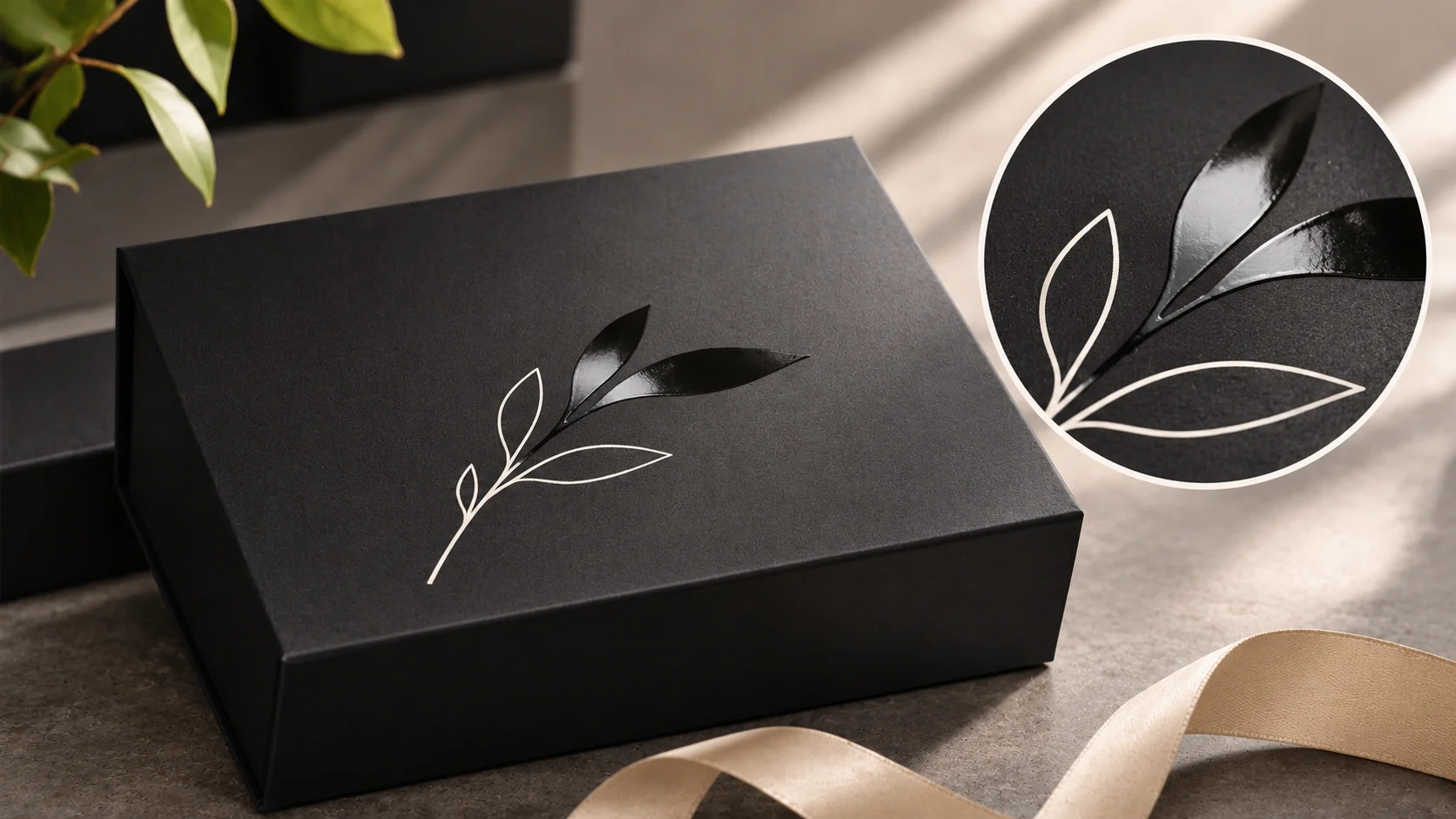
Option C — Combined ink and spot UV. A logo can be printed first, then selectively coated with UV varnish after the necessary intermediate processing. This can add gloss contrast to a colored design. Adhesion and registration must be verified.
6. What Is Raised UV? Is It the Same as Embossing?
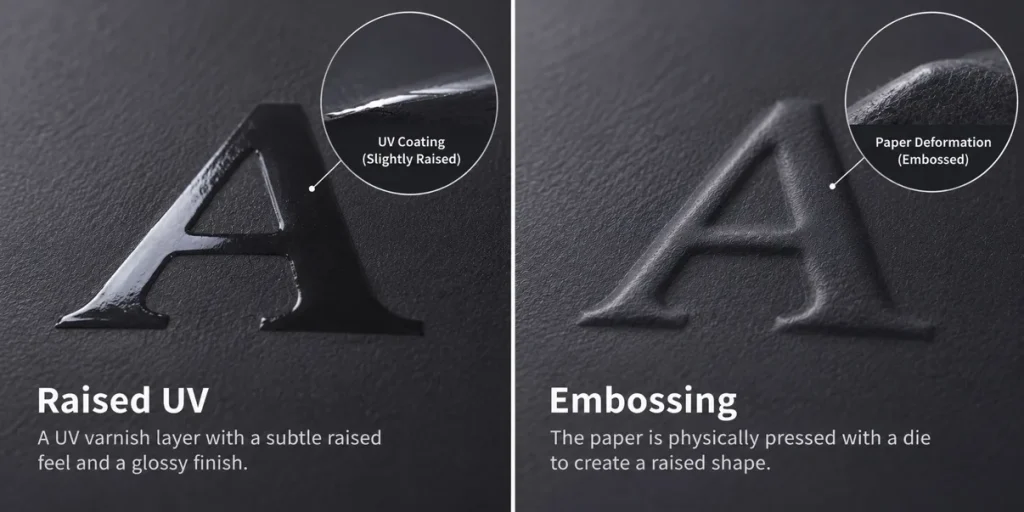
Raised UV is a selective UV coating formulated and applied to create a noticeable tactile layer. It can be produced by suitable screen-coating processes or specialized digital enhancement equipment. Not every spot UV finish is raised: a conventional gloss spot UV may have little perceptible relief.
Raised UV adds material on top of the surface. Embossing physically reshapes the paper or board using tooling and pressure. The two can look similar, but their structures and production requirements differ. Coating thickness, achievable detail, and tactile effect must be confirmed against the actual supplier process and approved sample.
Does Raised UV Work Equally Well on Large Areas?
Not necessarily. With conventional screen-applied raised UV, fine lines, lettering, and smaller design elements often produce a more noticeable tactile effect. On large solid areas, the coating may feel relatively flat because the raised edges are less apparent across the broad surface.
As a result, large-area raised UV may look and feel similar to conventional gloss spot UV, depending on the coating thickness and application method.
For buyers seeking a pronounced three-dimensional effect, embossing may be a more suitable option. The final result should always be confirmed with a physical sample.
7. Spot UV, Flood UV, and UV Ink Printing
These terms describe different things:
- Spot UV: UV-curable coating applied to selected areas.
- Flood UV: UV-curable coating applied across most or all of a designated surface.
- UV ink printing: Printing graphics with UV-curable inks; the application process may be offset, screen, digital inkjet, or another compatible technology.
A quotation that simply says “UV printing” can be ambiguous. Buyers should specify whether they need colored UV ink, clear spot varnish, full-surface coating, or a raised coating effect.
8. Which Finish Works for Paper Bags and Boxes?
Paper shopping bags: Screen-printed ink may suit simple logos on compatible papers. Spot UV may work on suitable coated or laminated surfaces, but folding, creasing, adhesion, and subsequent bag-making must be considered.
Rigid gift boxes: Matte surfaces with spot-gloss logos are a common premium effect. Screen printing can provide opaque or specialty-colored graphics. The coating position should be coordinated with wrapping, corners, and box construction.
Folding cartons: Finishes should be checked against the dieline. Thick coatings crossing fold lines may crack or affect converting. Confirm any required clearance and tolerances with the manufacturer rather than applying a universal number.
9. What Affects the Cost?
Cost depends on screen preparation, number of separations, coating coverage, material formulation, order quantity, registration tolerance, substrate compatibility, and any additional passes or curing steps.
There is no reliable universal rule that spot UV always costs more or less than screen-printed ink. Compare quotations using the same artwork, substrate, finish area, quantity, and quality requirements.
10. Common Quality Risks
Poor adhesion: Ink or varnish may fail to bond to some laminated or specialty surfaces. Conduct appropriate compatibility and adhesion checks.
Registration errors: A narrow spot UV highlight can visibly miss the printed artwork. Confirm practical tolerances for fine details.
Uneven coating: Deposit variation, substrate properties, or curing conditions can affect gloss and texture.
Cracking at folds: Thick or unsuitable coatings may crack across creases. Review the dieline before production.
Insufficient curing: Improper UV curing can cause tackiness or reduced performance. Follow the coating supplier’s specifications and validate production settings.
11. What Should Buyers Send to Their Supplier?
Before production, provide the packaging type and dimensions; paper or covering material; any lamination or base coating; artwork with a clearly separated ink or varnish mask; intended color, gloss, and tactile effect; order quantity; and handling requirements.
Ask the manufacturer to confirm minimum line width, registration tolerance, compatibility, fold-line restrictions, and whether a physical approval sample is required.
Final Thoughts
Factories may list “screen printing” and “spot UV” as different operations even when both use the screen-printing method. This is practical production terminology: one typically means applying colored ink; the other means applying selective UV varnish.
For packaging buyers, the important choice is the intended visual and tactile result, supported by clear artwork and a validated production sample.
At PackSavvy, we help buyers evaluate printing and finishing options for custom paper bags, rigid gift boxes, and folding cartons.
Planning a custom packaging project? Share your artwork, material, quantity, and preferred finish. Request a Quote.
© 2026 PackSavvy. Original editorial content and proprietary materials. All rights reserved where applicable.
For permission to reproduce, translate, or commercially reuse our proprietary content, please contact PackSavvy.