
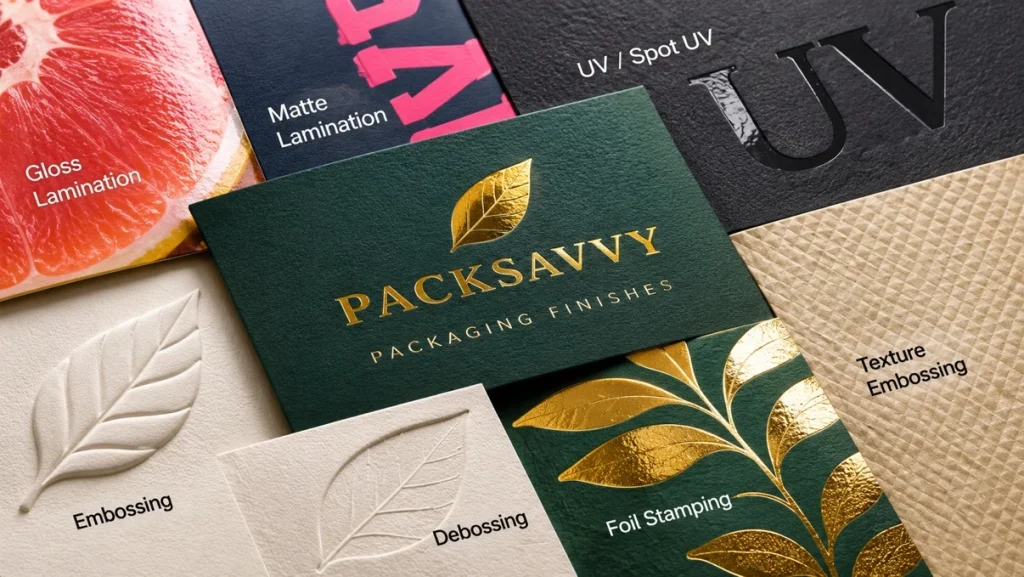
Surface finishing plays an important role in the appearance, feel, and performance of custom paper packaging. A carefully selected finish can make a paper bag look more refined, highlight a brand logo, add texture to a gift box, or improve resistance to everyday handling.
However, different finishing techniques serve different purposes. Some provide surface protection, while others are mainly decorative.
For packaging buyers, understanding these differences makes it easier to choose suitable finishes without adding unnecessary production costs.
This guide introduces the most common finishes used for custom paper bags, rigid gift boxes, and folding cartons, including their benefits, limitations, and typical applications.
1. Lamination: Matte, Gloss and Soft-Touch
Lamination involves bonding a thin film to the printed paper surface. It changes the appearance and feel of the packaging while providing an additional protective layer.
Gloss Lamination
Gloss lamination creates a shiny, reflective surface that can enhance the visual vibrancy of printed colors.
It is commonly used for retail paper bags, promotional packaging, and colorful printed cartons.
Main benefits:
- Bright, reflective appearance.
- Improved resistance to light scuffing and handling.
- Additional protection for the printed surface.
Considerations: Glossy surfaces can show fingerprints and reflections. The final appearance depends on the film, printed design, and lighting conditions.
Matte Lamination
Matte lamination produces a lower-gloss surface with a more restrained appearance.
It is frequently selected for premium shopping bags, gift boxes, and luxury retail packaging.
Main benefits:
- Subtle, sophisticated appearance.
- Reduced glare compared with gloss lamination.
- Suitable background for decorative finishes such as foil stamping and Spot UV.
Considerations: Some matte films, especially on dark printed backgrounds, may show scuff marks or fingerprints. Anti-scratch matte films are available when improved surface resistance is required.
Soft-Touch Lamination
Soft-touch lamination uses a specially designed film to create a smooth, velvety tactile effect.
It is commonly used for luxury gift boxes, cosmetics packaging, and premium presentation packaging.
Considerations: Soft-touch finishes may increase costs and can be susceptible to marking, depending on the material and handling conditions.
Buyer’s tip: Choose lamination based on the desired appearance, handling requirements, and end-market recycling considerations. Different films and paper constructions may behave differently in recycling systems.
2. Varnishing: Aqueous and Conventional Coatings
Varnishing applies a liquid coating to the printed surface to achieve a desired gloss level and provide a degree of surface protection.
Common finishes include gloss varnish, matte varnish, and water-based aqueous coatings.
Aqueous coating is widely used in commercial packaging printing and can be a cost-effective alternative to film lamination for certain applications.
Unlike lamination, varnishing does not involve bonding a separate plastic film to the paper.
Main benefits:
- Gloss or matte appearance.
- Improved resistance to light rubbing and handling.
- Suitable for many printed paper bags and folding cartons.
- Often economical for larger production runs.
Considerations: Protection depends on the coating formulation, coating weight, substrate, and application process. Varnishing does not necessarily provide the same barrier or abrasion resistance as lamination.
Water-based coatings should not automatically be described as environmentally friendly or fully recyclable without considering the complete packaging construction.
Buyer’s tip: If the packaging will experience frequent handling, rubbing, or exposure to moisture, confirm the required performance before choosing between varnishing and lamination.
3. UV Coating and Spot UV
UV coating is a liquid coating cured using ultraviolet light.
It can produce a glossy surface and is widely used to enhance printed packaging.
Overall UV Coating
Overall UV coating covers a broad area or the entire printed surface.
It is commonly used when a consistent surface appearance is required.
Spot UV
Spot UV applies a UV-curable coating only to selected areas of the design.
For example, a glossy Spot UV logo on a matte background creates contrast that draws attention to the brand without changing the entire printed surface.
Main benefits:
- Strong visual contrast.
- Emphasis on logos, text, or decorative patterns.
- Additional design interest without introducing another printed color.
Considerations: Fine details require accurate registration. The coating must also be compatible with the underlying print, paper, and any other surface finish.
Folding or creasing areas may require special attention to reduce the risk of cracking.
Raised UV
Raised UV uses a thicker coating deposit to create a tactile, elevated effect.
Although it may resemble embossing visually, the raised effect is formed by the coating rather than mechanically deforming the paper.
Buyer’s tip: Standard Spot UV and Raised UV are not interchangeable. If a noticeable raised texture is required, specify it clearly when requesting samples and quotations.
4. Foil Stamping: Metallic Highlights
Foil stamping transfers a decorative foil onto the paper surface, typically using heat and pressure.
Gold and silver are the most familiar options, but other colors and finishes are also available.
Foil stamping is commonly used to highlight brand logos, product names, borders, and decorative details.
Main benefits:
- Distinctive metallic appearance.
- Strong brand emphasis.
- Premium visual presentation.
Considerations: Very fine lines, small reversed text, heavily textured papers, and large solid foil areas may require special attention.
Foil adhesion and coverage depend on the foil, substrate, surface treatment, and production settings.
Buyer’s tip: Foil stamping and metallic ink printing are different processes. Metallic ink can create a metallic appearance, but it generally does not reproduce the same reflective effect as metallic foil.
5. Embossing and Debossing: Raised and Recessed Details
Embossing and debossing use mechanical pressure and tooling to create three-dimensional details in paper or paperboard.
Embossing
Embossing raises selected areas above the surrounding surface.
It is commonly used for logos, lettering, and decorative patterns.
Debossing
Debossing creates a recessed impression by pressing selected areas into the surface.
Both techniques can produce a subtle, tactile appearance without relying entirely on ink or foil.
Main benefits:
- Physical texture and depth.
- Distinctive brand presentation.
- Effective decorative detail on suitable paper materials.
Considerations: Paper thickness, board construction, tooling, and artwork detail affect the achievable depth and definition.
Some embossing or debossing processes may create a corresponding impression on the reverse side. The design and construction should be evaluated before production.
Combining Embossing with Foil Stamping
Foil stamping and embossing can be combined to create a raised metallic design.
This technique is often used for premium logos and decorative details.
Buyer’s tip: Request a physical sample when the depth, sharpness, or reverse-side appearance is important.
6. Texture Embossing: Adding an Overall Surface Pattern
Texture embossing creates a repeated pattern across a larger area of paper or paperboard.
Common effects include linen-like, leather-like, and geometric textures.
Unlike localized logo embossing, texture embossing is generally used to change the overall surface character of the packaging.
Main benefits:
- Distinctive tactile surface.
- Decorative visual texture.
- Enhanced material presentation.
Considerations: Texture patterns may affect the appearance of fine printed details and the performance of subsequent finishing processes.
The final result depends on the paper material, embossing pattern, and production sequence.
Texture embossing is often used for premium shopping bags, decorative wraps, and rigid gift boxes.
7. Comparison of Common Paper Packaging Finishes
| Finish | Main Effect | Common Applications | Key Consideration |
|---|---|---|---|
| Gloss Lamination | Shiny protective film | Retail bags, colorful cartons | Reflections and fingerprints |
| Matte Lamination | Low-gloss protective film | Premium bags and gift boxes | Scuff marks on dark colors |
| Soft-Touch Lamination | Velvety tactile surface | Luxury packaging | Cost and surface marking |
| Varnishing | Liquid surface coating | Paper bags and folding cartons | Protection varies by formulation |
| Overall UV | UV-cured surface coating | Printed cartons | Coating and crease compatibility |
| Spot UV | Selective glossy highlights | Logos and decorative graphics | Registration accuracy |
| Raised UV | Raised coating effect | Premium graphic details | Height and coating compatibility |
| Foil Stamping | Metallic decorative effect | Logos and luxury packaging | Adhesion and fine details |
| Embossing / Debossing | Raised or recessed details | Logos and patterns | Board thickness and reverse-side marks |
| Texture Embossing | Repeated surface texture | Bags, wraps and gift boxes | Compatibility with printed details |
8. How to Choose the Right Finish
The best finish depends on the product, material, design, handling conditions, and budget.
For Custom Paper Bags
Matte and gloss lamination are common options for printed retail shopping bags.
Suitable varnishes may also be considered depending on the required appearance and performance.
Foil stamping or embossing can be added when stronger brand emphasis is needed.
For Rigid Gift Boxes
Premium rigid boxes often use combinations of matte lamination, foil stamping, embossing, or textured paper.
Soft-touch lamination may be appropriate when tactile presentation is a priority.
However, adding more finishing processes does not automatically create a better result. A restrained design with one carefully selected decorative finish can be equally effective.
For Folding Cartons
Varnishing, UV coating, lamination, Spot UV, and foil stamping are commonly considered for folding cartons.
Material compatibility and crease performance are particularly important because cartons must be folded during production and assembly.
For Sustainability-Focused Packaging
Surface finishing should be evaluated as part of the complete packaging construction.
Paper selection, coating chemistry, films, adhesives, recycling infrastructure, and destination-market requirements all influence the final assessment.
No single finishing method should automatically be described as sustainable without supporting evidence.
9. Can Different Finishes Be Combined?
Yes. Many packaging designs use more than one surface finishing process.
Common combinations include:
- Matte Lamination + Spot UV: Creates glossy highlights against a low-gloss background.
- Matte Lamination + Foil Stamping: Combines understated surfaces with metallic branding.
- Foil Stamping + Embossing: Creates raised metallic decorative details.
- Textured Paper + Foil Stamping: Combines tactile paper surfaces with metallic highlights, subject to material compatibility.
Combining finishes requires attention to process sequence, registration, material compatibility, and production tolerances.
A physical sample is recommended before confirming a complex finishing combination.
10. Final Thoughts
The right paper packaging finish should support both the design and the practical requirements of the product.
Lamination and varnishing are often selected for appearance and surface protection, while foil stamping, UV effects, and embossing provide additional decorative possibilities.
For most packaging projects, selecting one or two suitable finishes is more effective than combining too many processes.
At PackSavvy, we help buyers evaluate paper materials, printing methods, surface finishes, and production requirements for custom paper bags, rigid gift boxes, and folding cartons.
Share your packaging dimensions, artwork, estimated quantity, and preferred finishing effects to discuss suitable options.
© 2026 PackSavvy. Original editorial content and proprietary materials. All rights reserved where applicable.
For permission to reproduce, translate, or commercially reuse our proprietary content, please contact PackSavvy.