
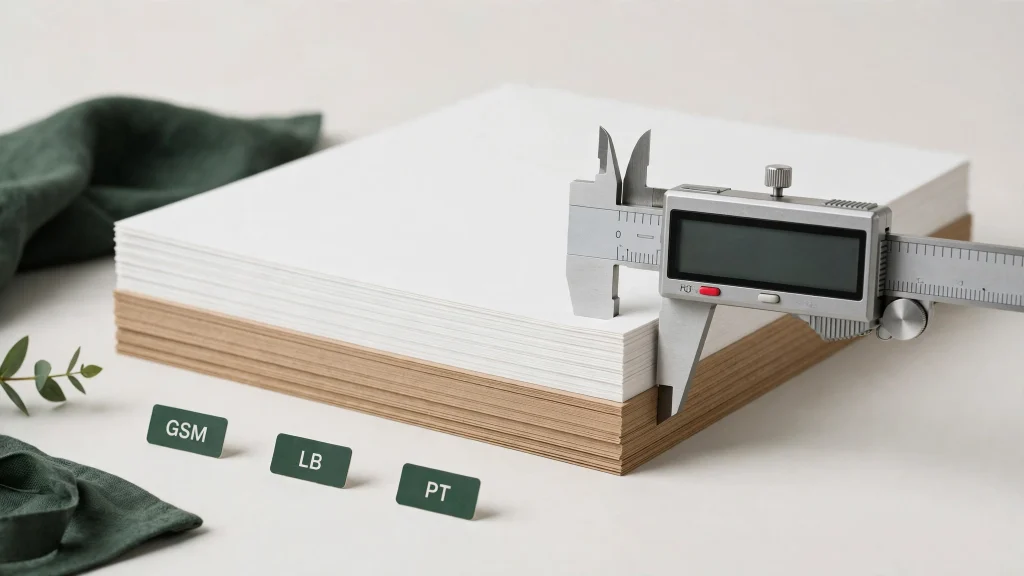
When sourcing paper bags, folding cartons, or rigid gift boxes, buyers often encounter different paper specifications depending on the supplier and market.
A European supplier may quote paper in GSM, while an American buyer may request 100# Cover or 18pt paperboard.
These measurements are not interchangeable without understanding what each unit represents.
In this guide, we explain the differences between GSM, lb, and pt, provide practical conversion formulas, and show how to avoid common mistakes when specifying paper for custom packaging.
1. What Is GSM?
GSM stands for grams per square meter (g/m²). It measures the mass of one square meter of paper or paperboard.
For example:
- 120 GSM paper weighs 120 grams per square meter.
- 250 GSM paperboard weighs 250 grams per square meter.
- 350 GSM paperboard weighs 350 grams per square meter.
GSM is widely used internationally because it provides a consistent basis for comparing paper weight, regardless of sheet dimensions.
However, GSM measures basis weight, not thickness.
Two paperboards with the same GSM can have different thicknesses, stiffness, and bending performance because of differences in fiber composition, density, coating, and manufacturing processes.
For packaging applications, GSM is an important specification, but it should not be the only consideration.
2. What Does LB or # Mean in American Paper Specifications?
In the United States, paper is often specified using pounds (lb), sometimes written with the # symbol.
For example:
- 80# Text
- 100# Cover
- 20# Bond
These labels refer to the weight of 500 sheets of paper at a defined basis size for that paper category.
The important point is that different paper categories use different basis sizes.
As a result, 100# Text and 100# Cover do not have the same GSM.
Common US Paper Categories
| Paper Category | Basis Sheet Size | Approximate GSM per lb |
|---|---|---|
| Bond / Writing | 17 × 22 inches | 3.7597 |
| Text / Book | 25 × 38 inches | 1.4801 |
| Cover | 20 × 26 inches | 2.7041 |
| Index | 25.5 × 30.5 inches | 1.8080 |
These factors apply to the specified US paper categories and their conventional 500-sheet basis-weight system.
Examples
80# Text
80 × 1.4801 ≈ 118 GSM
100# Cover
100 × 2.7041 ≈ 270 GSM
20# Bond
20 × 3.7597 ≈ 75 GSM
This explains why a buyer should never convert a paper specification expressed only as “100 lb” without first identifying the paper category.
3. Interactive Paper Weight Conversion Calculator
Use the calculator below to convert common US paper basis weights into GSM or convert GSM into the corresponding US basis weight.
Select the appropriate paper category before entering a value.
Paper Weight Conversion Calculator
Convert US paper basis weights to GSM, paperboard thickness from points to millimetres, or estimate GSM from thickness and bulk.
270.4 GSM100 lb Cover × 2.7041 = 270.4 GSM
The lb conversion depends on the paper category: each category uses a different basis sheet size. 100# Text and 100# Cover are not the same GSM.
0.4572 mm · 457.2 μm18 pt × 0.0254 = 0.4572 mm | 18 pt × 25.4 = 457.2 μm
This is an exact unit conversion: 1 pt = 0.001 inch = 0.0254 mm = 25.4 μm.
Example: 18 pt with bulk 1.4 cm³/g → 457.2 μm ÷ 1.4 ≈ 326.6 GSM (estimate).
This is an estimate based on the supplied bulk value. Actual paperboard specifications should be confirmed with the manufacturer’s technical data sheet.
All calculations run in your browser. No data is sent to a server.
The calculator should support:
- US lb / # → GSM
- GSM → US lb / #
- pt → mm and μm
- Optional estimated GSM from pt and known Bulk
Important: The lb conversion depends on the selected paper category. The pt-to-GSM calculation requires an additional material property and should not be presented as an exact conversion based on thickness alone.
4. What Does PT Mean in Paperboard Specifications?
In American paperboard specifications, pt generally refers to a point of caliper, equal to one-thousandth of an inch.
Unlike GSM, pt describes physical thickness.
The conversion is:
1 pt = 0.001 inch = 0.0254 mm = 25.4 μm
Common Paperboard Thickness Conversions
| Thickness | Millimeters | Micrometers |
|---|---|---|
| 10 pt | 0.254 mm | 254 μm |
| 12 pt | 0.3048 mm | 304.8 μm |
| 14 pt | 0.3556 mm | 355.6 μm |
| 16 pt | 0.4064 mm | 406.4 μm |
| 18 pt | 0.4572 mm | 457.2 μm |
| 20 pt | 0.508 mm | 508 μm |
| 24 pt | 0.6096 mm | 609.6 μm |
For example, an 18pt paperboard has a nominal thickness of approximately 0.457 mm.
However, this does not automatically tell us its GSM.
In this context, pt means caliper points. It should not be confused with the typographic point used to measure font sizes.
5. Can You Convert PT Directly to GSM?
Not accurately without additional information.
GSM measures mass per unit area, while pt measures thickness.
To relate the two, we need to know the paperboard’s density or bulk.
Bulk describes the volume occupied per unit mass and is commonly expressed in cm³/g.
The relationship is:
GSM = Thickness (μm) ÷ Bulk (cm³/g)
For example, consider an 18pt paperboard:
18 × 25.4 = 457.2 μm
If its bulk is:
- 1.2 cm³/g → approximately 381 GSM
- 1.4 cm³/g → approximately 327 GSM
- 1.6 cm³/g → approximately 286 GSM
These figures are mathematical examples using assumed bulk values, not universal specifications for 18pt paperboard.
Different grades, including solid bleached sulfate (SBS), folding boxboard (FBB), and other paperboard constructions, may have different relationships between thickness and grammage.
Buyer’s tip: When a customer requests 18pt board, ask for the paper grade or material specification before recommending a GSM equivalent.
6. What About LB/MSF?
Some US paperboard and packaging specifications use lb/MSF, meaning pounds per 1,000 square feet.
This is an area-based weight measurement and should not be confused with the conventional 500-sheet basis-weight system used for Text, Cover, Bond, or Index papers.
The conversion is:
GSM = lb/MSF × 4.8824
For example:
100 lb/MSF ≈ 488 GSM
Always check whether a quoted pound value refers to a paper category’s basis weight or a specified area.
7. Why Paper Weight and Thickness Both Matter in Packaging
For custom packaging, selecting paper solely by GSM may not produce the expected result.
Paper Shopping Bags
Paper bags require suitable strength, folding performance, and handling characteristics.
Paper weight is important, but fiber properties, paper grade, bag construction, handle attachment, and intended load also affect performance.
Folding Cartons
Folding cartons require an appropriate balance of stiffness, thickness, creasing performance, and printability.
Two boards with identical GSM may behave differently during die-cutting, folding, and assembly.
Rigid Gift Boxes
Rigid gift boxes commonly use thick greyboard or other structural boards covered with printed or decorative paper.
The structural board and wrapping paper should be specified separately.
For example, a rigid box may use millimeter-based greyboard thickness together with GSM-based wrapping paper specifications.
In such constructions, the thickness of the assembled box wall is not determined by the wrapping paper GSM alone.
8. Common Paper Specification Mistakes
Mistake 1: Treating 100# Text and 100# Cover as Equal
They use different basis sheet sizes and therefore represent different grammages.
Mistake 2: Assuming 18pt Always Equals a Fixed GSM
Thickness alone does not determine mass per unit area.
Mistake 3: Comparing GSM Without Considering Paper Grade
Paperboards with the same GSM can differ in stiffness, thickness, surface quality, and conversion performance.
Mistake 4: Confusing LB with LB/MSF
These are different specification systems and require different conversion formulas.
Mistake 5: Specifying Only One Property
For packaging where caliper or stiffness is critical, providing only GSM may be insufficient.
9. What Should Buyers Include in a Paper Specification?
For accurate quotations and material selection, buyers should provide as much relevant information as possible.
| Specification | Example |
|---|---|
| Paper grade | SBS / FBB / Kraft / Greyboard |
| Basis weight | 350 GSM |
| Thickness, if critical | 0.45 mm |
| Surface | Coated / Uncoated |
| Packaging application | Folding carton |
| Printing requirements | CMYK + Foil Stamping |
| Order quantity | 10,000 pieces |
If an existing sample is available, supplying the sample or the manufacturer’s technical data sheet can help avoid misunderstandings.
10. Final Thoughts
GSM, lb, and pt are all useful paper specifications, but they describe different properties or use different measurement conventions.
GSM provides a consistent measure of mass per unit area.
US lb or # specifications require the correct paper category and basis size.
PT describes paperboard thickness and cannot be converted accurately to GSM without additional material information.
For custom paper bags, folding cartons, and rigid gift boxes, the most reliable approach is to specify the paper grade, grammage, and thickness when relevant.
At PackSavvy, we help buyers evaluate paper materials and packaging constructions based on the requirements of their products and designs.
© 2026 PackSavvy. Original editorial content and proprietary materials. All rights reserved where applicable.
For permission to reproduce, translate, or commercially reuse our proprietary content, please contact PackSavvy.